
Disclaimer: The incident described in this article is entirely fictitious. The companies, individuals and events referred to have been created solely to illustrate genuine insurance principles commonly encountered within the freight and logistics industry. Any resemblance to actual persons or organisations is purely coincidental. The insurance concepts discussed, however, accurately reflect the practical operation of Goods in Transit Insurance, Carriers’ Liability Insurance and related policy conditions.
One Truck. R10 Million in Cargo. One Very Expensive Assumption.
A fully laden truck bursts into flames on Van Reenen’s Pass. Within minutes, R10 million worth of cargo is destroyed.
One customer alone loses R6 million worth of Hisense, Samsung, and TCL televisions. They expected to be fully compensated.
Many businesses assume that once they hand their goods to a transport company, those goods are automatically insured for their full value. Unfortunately, this is one of the most common and costly misconceptions in the freight industry.
A recent road accident in South Africa highlights this point. An oncoming vehicle crossed the centre line on Van Reenen’s Pass and had a head-on collision with the vehicle of AMX Logistics. The freight vehicle burst into flames, and the entire load was lost.
AMX Logistics was carrying a mixed load, including that of VoltEdge Electronics, (a South African electronics distributor) who had Hisense, Samsung and TCL televisions valued at R6 million on the vehicle.
The police report concluded that the driver of the transport vehicle was not at fault. Stuart Hepplewhite, the MD of VoltEdge, instituted a claim of R6m against the transport company as he had been told that all vehicles had full G.I.T. cover on them.
A G.I.T. (Goods in Transit) policy covers the value of the goods themselves, subject to the policy terms, conditions, and specified risks. Cover generally applies regardless of who is responsible for the loss, provided the incident falls within the scope of the policy.
Let’s look at what transpired.
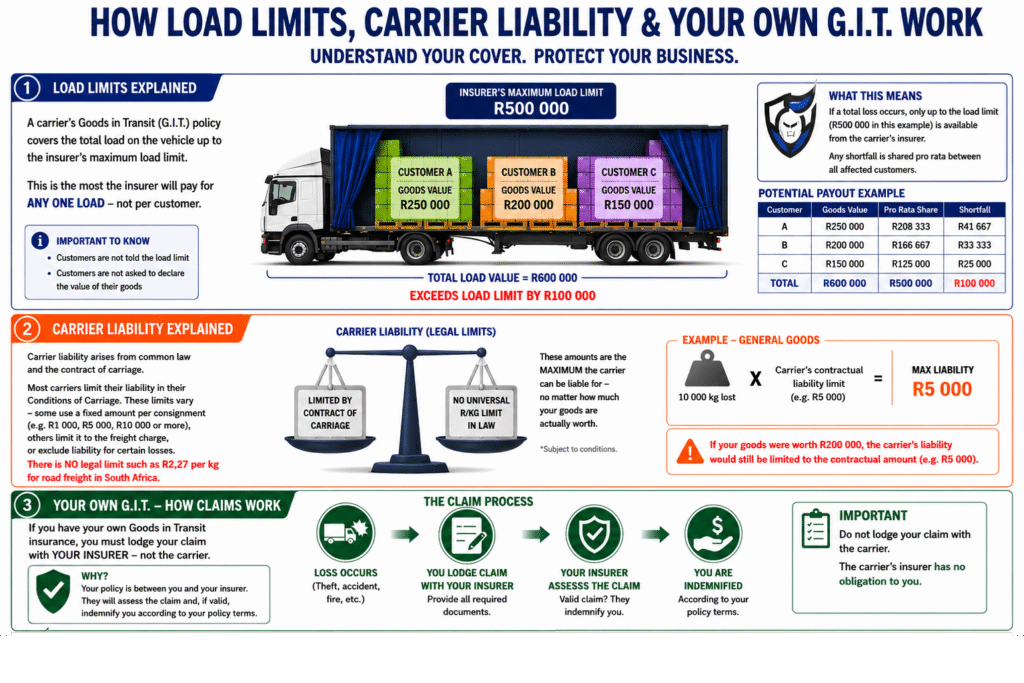
Most reputable transport companies do have a Goods in Transit (G.I.T.) insurance policy in place to protect themselves against claims for losses and damage while goods are in their possession. However, these policies are almost always subject to a maximum load limit per vehicle. This is the maximum amount the insurer will pay for the entire load being transported—not for each customer’s shipment.
AMX Logistics did indeed have G.I.T cover, but there was a load limit of R3m per vehicle. When all the consignors had submitted their claims, the total value of all goods on the vehicle was determined to be R10m. If the actual value of the goods being transported exceeds the declared load limit, the insurer considers you to be underinsured. When this happens, the Average Clause is applied. This means you become your own insurer for the uninsured portion of the risk and must share in the loss.
In this instance the insurers applied the average clause. This is the formula that is used to calculate how much each claimant will receive.
The insurer compared: Declared Load Limit ÷ Actual Value of Goods × Amount of the Loss = Claim Payable
- Declared Load Limit: R3,000,000
- Actual Value of Goods on the Vehicle: R10,000,000
- Loss Sustained: R10,000,000
Calculation:
R3,000,000 ÷ R10,000,000 x R10,000,000 = R3,000,000 (which is 30% insured)
With regards to VoltEdge’s claim for R6m, when the claim was finally settled, the insurer only paid out R1,8m
(30% × R6,000,000, = R1,800,000)
Lesson learnt:
If the total value of all freight on a vehicle exceeds the carrier’s insured load limit—as is often the case—the available insurance may be insufficient to cover the full loss following a hijacking, fire, rollover, or other catastrophic event. Any settlement will have to be shared proportionately between all affected consignors, leaving each customer with only a fraction of the value of their goods. Particularly as the freight company does not know the value of the goods consigned.
Understanding the limitations of a carrier’s insurance is essential. Stuart Hepplewhite was understandably upset and insisted that AMX Logistics claim under their Carriers’ Liability Policy for the balance of R4,200,000.
Carriers Liability Insurance
Carriers Liability Insurance is designed to protect the transport company or carrier, not the owner of the goods.
This insurance responds only when the carrier is legally liable for the loss or damage. Before a claim is paid, it must be established that the carrier was negligent or legally responsible for the incident. If the carrier is not legally liable, the policy will generally not respond, even if the goods have been lost or damaged.
In the above case, the SAP’S investigation had already concluded that there was no act of negligence on the part of the driver so Carriers Liability would not come into play.
Key point: Carriers’ Liability Insurance protects the carrier’s legal liability, not the value of your goods. In addition, there is no set amount that a Carriers Liability policy will cover; it is based on the terms and conditions of the contract that the freight company trades under and will have generally been accepted by the customer when they signed the Credit application.
Stuart Hepplewhite accepted the payout of R1,8m but immediately ceased trading with AMX Logistics. When later discussing the matter at their Regional conference with the AMX Group FD, Derick Harper, he found out that AMX had a comprehensive G.I.T. policy in place with a load limit of R15,000,000.
Although some 6 months had passed since the incident, Stuart instructed his finance GM to lodge the claim with their insurers. One can only imagine his shock when the insurer declined the claim.Phoenix Insurance’s Mike Braithwaite explained their decision as follows:
Insurance contracts are founded on the principle of uberrimae fidei — utmost good faith — which requires both the insurer and the insured to act honestly and disclose material information throughout the insurance relationship. In this instance, however, the primary issue was not one of disclosure but of compliance with the policy conditions.
VoltEdge failed to notify us of the loss for more than six months after it occurred. As a result, we were deprived of the opportunity to appoint our own loss adjuster, investigate the circumstances of the loss while the evidence was still available, inspect the damaged goods, verify the quantum of the claim, and determine whether any recovery action could be pursued against responsible third parties.
More significantly, VoltEdge accepted a payment of R1.8 million in full and final settlement from the carrier’s insurer without our knowledge or consent. By doing so, they compromised and extinguished our rights of recovery under the doctrine of subrogation. The combination of the late notification and the prejudice to our rights of recovery meant that we were unable to consider the claim in accordance with the terms of the policy.
The Key Message for Consignors
Before your goods leave your premises, ask yourself three questions:
- Do I know the value of the goods being transported?
- Do I know the carrier’s maximum insured load limit?
- If there is a major loss today, am I relying on someone else’s insurance to protect my business?
If you cannot answer “yes” to all three questions, it may be time to review how your goods are insured while in transit with your broker. Freight Company operators have shareholders too and cannot be expected to expose themselves to financial ruin by accepting the financial obligations consignors wish to impose upon them often without a fee.
Conclusion:
Although all companies and personnel mentioned are fictitious, this blog highlights the reality many businesses face when consigning freight.