
Road freight has become the shock absorber of a broken logistics chain, and this, in turn, leads to more pressure on depots, freight management systems, and, most importantly, harms the drivers themselves. This is the crux of this article.
For quite some time now, road freight has become the backbone of the freight industry in South Africa. Part of this is because port congestion and the collapse of the rail infrastructure have forced freight onto trucks. Another reason is because of the inherent instability of the fuel process, which has made air freight a very expensive option, even for time-sensitive freight.
Another contributing factor to road freight being the choice of transport is the boom in e-commerce sales. This means that every online order triggers a complicated process of order fulfilment, including warehousing, picking and packing, line haul distribution, and finally, last-mile delivery. This equates to more trucks on the road carrying heavier loads due to the consolidation of vehicles in an effort to minimise the impact of staggered fuel price hikes and longer transit times.
When road freight volumes spike to the point where the freight system is under strain, depots become congested, offloading takes longer, and cross-docking slows down as too many vehicles arrive, carrying too much freight to be efficiently offloaded and distributed.
This results in freight missing connections and services such as overnight or next day becoming extended beyond 24 hours. So it’s not just the road, it’s the entire handling chain slowing down.
In essence, although road freight is growing, it is not because of its super-efficiency but rather because all other transport modes are failing.
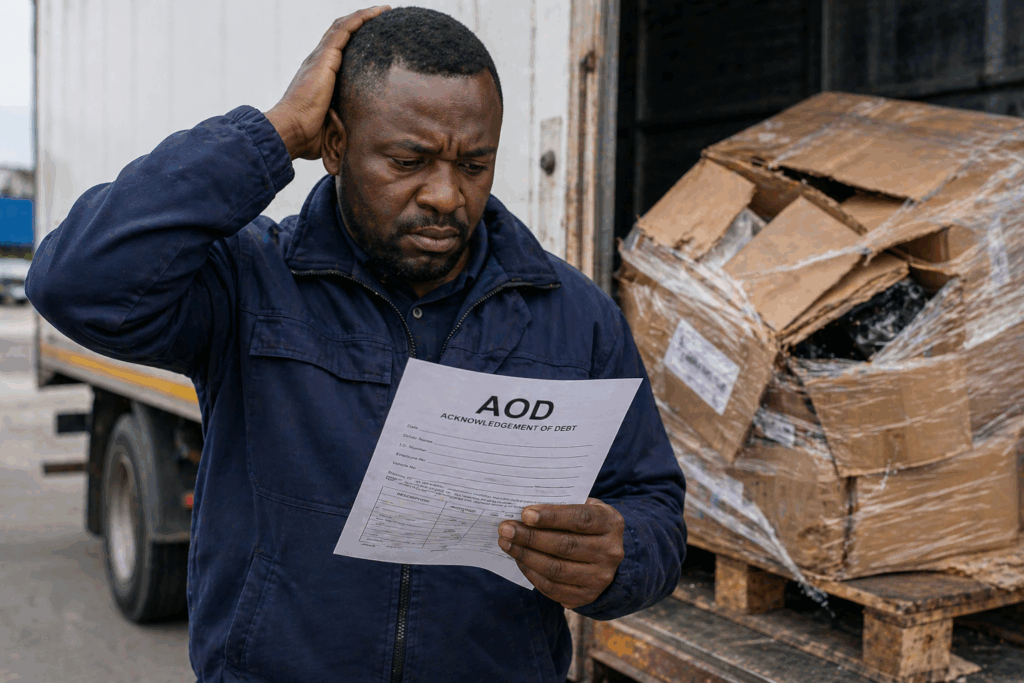
Even though many losses and damages come from overloading combined with poor packaging practices, or a poorly selected freight mix, which leads to the consignment of incompatible freight and unrealistic delivery schedules, the cost gets pushed onto the driver, the last link in the chain, under an AOD.
An Acknowledgement of Debt (AOD) is a document that freight companies get their drivers to sign when claims have been made against them for goods lost or damaged. In some instances, the driver is at fault due to reckless behaviour and by ignoring established freight protocols and procedures, and I have no issue with that.
But in many cases, the driver bears the cost of someone else’s mistake. Several issues with this approach render it non-viable in the long term, in my opinion. The first is the moral and legal question.
The Basic Conditions of Employment Act states that for a deduction to be lawful, a full investigation of the causes of loss and damage must have been carried out whereby it was proven that the loss or damage was directly caused by the driver’s negligent actions, there must have been a fair and thorough formal disciplinary hearing, and the driver must agree to the AOD in writing.
In addition, the amount deducted cannot exceed 25% of the driver’s net remuneration in any given work period.
So, in practical terms, if a driver’s net pay for the month is R12,000, the normal maximum deduction from salary for that month would be R3,000. Any balance would usually need to be recovered over later pay periods, within the same limit, unless there is a court order or another lawful basis.
The second major issue is that, although on paper, it looks like consent, in practice, these AODs are issued where a full investigation of the circumstances of loss or damage has not been conducted, and it has not been conclusively proven that the driver was at fault. The driver has been forced to sign the AOD under the pressure of losing his job, and this not only lowers staff morale, but creates an environment where potentially the driver could engage either directly or indirectly in criminal behaviour to either recoup his loss or get retribution.
It is, unfortunately, not uncommon for staff of freight organisations to be involved with syndicated theft rings that target specific products being consigned. The freight staff have access to these commodities and are often complicit in their theft; sometimes they have been coerced, but other times they willingly participate, particularly if they themselves are under financial pressure.
A smarter approach would be for freight operators to become more fully immersed in risk management techniques. This would involve claims data analysis to identify the root causes of loss or damage. Was it syndicated theft of targeted freight?
Study what commodities were damaged and in what regions the damage occurred.
Was the poor packaging and freight preparation a contributory cause to the damage sustained? Were there loading issues, such as overloading, which potentially could have caused pallets to collapse? Are the majority of damages coming from regions with known poor road infrastructure?
This approach shifts the focus so that it is on correcting systemic issues and not on blaming only the individual drivers, because the reality is you can recover R3000 from a driver to offset the cost of a claim in the short term, or you could identify and rectify the operational issues that are costing you R300,000 per annum.
As pressure on the road freight sector continues to grow, so does the need for more sustainable approaches to risk management. While AODs may appear to provide a straightforward solution to recovering losses, they often overlook the complex factors that contribute to damage and loss within the logistics chain.
Shifting the focus toward data-driven insights and preventative measures allows freight operators to address the root causes rather than the symptoms. In doing so, the industry not only protects its bottom line but also fosters a fairer and more accountable working environment for drivers
The future of freight doesn’t lie in shifting blame; it lies in understanding risk, improving systems, and building a model where accountability is fair, informed, and sustainable.