
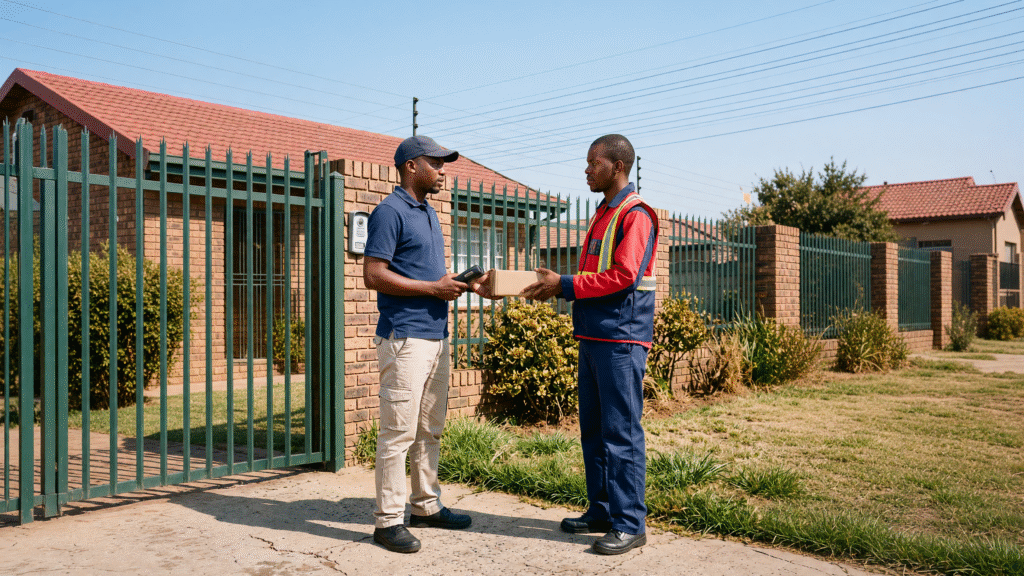
Rather than competing for every small parcel, could the Post Office use its national footprint to provide last-mile delivery services to private courier companies? The opportunity is there, but there is one major obstacle: trust.
In my previous blog, I examined the continuing dispute over SAPO’s exclusive rights to deliver parcels weighing less than 1kg.
The Minister has published a determination removing small parcels from SAPO’s exclusive domain, but the Post Office’s business-rescue practitioners maintain that the exclusivity remains effective pending the necessary regulatory processes.
While that dispute continues, I believe there is another aspect of SAPO’s future that deserves consideration.
Could the Post Office actually become a valuable commercial partner to the private courier industry?
It may sound unlikely, particularly given the history of the dispute, but there is a potential opportunity that could benefit both SAPO and private courier operators.
And it starts with SAPO’s national footprint.
The last-mile delivery problem
One of the challenges facing courier companies is the cost of delivering parcels to areas where there is insufficient volume to justify a dedicated delivery operation.
Consider the following example:
A courier company collects a parcel in Johannesburg for delivery to a customer in a remote area of the Eastern Cape. The courier has sufficient volume to transport the parcel to Mthatha, but the final destination may be another 80km away, on a route where there are relatively few deliveries.
Sending a dedicated vehicle to deliver one or two parcels over that distance may simply not be commercially viable. The courier could subcontract the delivery to another operator, but what happens if there is no established courier service in the area?
This is where SAPO’s existing network could potentially offer an alternative. If SAPO has an operational presence in that area, why could the courier not hand the parcel over to SAPO for the final delivery?
SAPO would earn revenue from the delivery, the courier would avoid the cost of operating its own vehicle over an uneconomical route, and the customer would receive the parcel.
The reverse arrangement could also work.
SAPO could collect parcels through its service points and contract with private courier companies to undertake the long-distance transport or final delivery. There would be no need for either party to duplicate infrastructure unnecessarily. This is not an entirely new concept. Courier companies regularly use subcontractors, agents and network partners to extend their geographical reach.
The difference is that SAPO has an established national footprint and a public-service mandate that includes providing access to postal services in areas where commercial delivery volumes may be limited.
That footprint could potentially become a source of additional revenue.
The legislation already provides for this
There is an interesting development that has received relatively little attention.
In December 2024, the South African Post Office SOC Ltd Amendment Act was signed into law.
The legislation provides for a broader SAPO mandate, including logistics and e-commerce services, partnerships with other logistics operators and the use of third-party infrastructure.
Its commencement is subject to proclamation, but the intended direction is clear: SAPO is to expand beyond its traditional postal activities.
The Department of Communications and Digital Technologies has described the objective as repositioning SAPO as an e-commerce and logistics service provider, as well as a partner to other industry participants.
In other words, the government has already contemplated a business model in which SAPO works with the private logistics industry. The opportunity would be to turn that concept into a commercially viable service.
Rather than trying to compete with established courier companies on every route, SAPO could concentrate on those parts of its network where it has something of value to offer.
That could include last-mile deliveries in remote areas, parcel collection services and the use of selected Post Office branches as collection and distribution points. But there is a considerable difference between having a branch network and having an operational courier network.
Does SAPO actually have the capacity?
SAPO entered business rescue in July 2023 and subsequently underwent extensive restructuring.
Thousands of employees were retrenched, branches were closed and its operating structure was substantially reduced.
Its financial position has reportedly improved, but that does not necessarily mean that its remaining infrastructure is capable of providing a reliable parcel delivery service. Before any courier company could consider using SAPO as a delivery partner, it would need to establish exactly what operational capacity SAPO has available.
How many branches are actually operational? Which branches can receive, process, and dispatch parcels?
Does SAPO have vehicles and delivery personnel available in the areas where courier companies require assistance?
What delivery volumes could it accommodate, and what would the service cost?
These are not questions that can be answered simply by looking at the number of Post Office branches on a map.
A branch that is open to the public is not necessarily equipped to operate as a parcel distribution depot.
However, if SAPO has operational infrastructure in areas where private courier companies have limited coverage, there may be an opportunity worth investigating.
The biggest obstacle is trust
Even if SAPO has the necessary infrastructure, there is another issue that would need to be addressed.
Would private courier companies trust SAPO with their customers’ parcels? This is perhaps the most important question of all.
The courier industry has spent years developing systems to provide customers with accurate tracking information, electronic proof of delivery, delivery notifications and predictable transit times.
E-commerce has made these requirements even more important. A customer ordering a product online expects to know when it has been collected, where it is in the delivery process, and when it will arrive.
The retailer, in turn, needs to know whether the delivery was completed successfully, whether the customer was available and what happened if the parcel was lost or damaged.
A courier company handing a parcel to SAPO for final delivery would need the same level of information and accountability that it expects from any other delivery partner.
Consider the position of the original courier company. It has accepted a parcel from its customer and undertaken to deliver it to the recipient.
If it hands that parcel to SAPO and the delivery goes wrong, the customer is unlikely to be interested in which operator was responsible. The customer will look to the courier company that accepted the consignment.
That courier therefore needs to know that SAPO can deliver the parcel within an agreed time frame, provide accurate tracking information and produce reliable proof of delivery. And if something goes wrong, there must be an effective process for resolving the problem.
This brings us to another important consideration.
Who pays when a parcel is lost or damaged?
If SAPO were to operate as a last-mile delivery partner, the question of liability would need to be addressed before the first parcel was handed over.
Consider a parcel collected by a private courier in Johannesburg and handed to SAPO in Mthatha for final delivery.
The parcel is subsequently damaged or goes missing.
Who is responsible? Would SAPO accept liability for loss or damage occurring while the parcel was in its care, custody, and control? What liability limits would apply? Who would investigate the claim, and how quickly would a decision be made?
Would the original courier company have to compensate its customer and then attempt to recover the money from SAPO?
These matters would need to be clearly defined in a commercial agreement between the parties.
The agreement would also need to address packaging standards, the condition of parcels at the point of handover, electronic proof of delivery and the procedures to be followed when goods are received damaged.
Without these safeguards, a courier company could find itself carrying the financial and reputational consequences of a delivery failure over which it had little control. The commercial opportunity may be attractive, but it would only work if both parties accepted clearly defined responsibilities.
The customer is already changing the delivery model
There is another reason why SAPO’s existing network could become commercially relevant.
Customers are increasingly being offered alternatives to traditional door-to-door delivery.
A customer can already purchase a product online and elect to collect it from a convenient parcel locker, retail collection point or designated pick-up location rather than having it delivered to their home or office.
For the courier company, this can reduce the cost of making individual deliveries. Instead of sending a driver to 30 different residential addresses, a courier could deliver a batch of parcels to a single collection point. The customer then collects the parcel at a convenient time.
SAPO could potentially participate in this market by making suitable branches available as parcel collection and drop-off points.
But the same commercial requirements would apply. The locations would need to be convenient, the operating hours suitable, the parcels secure, and the collection process efficient. Customers would also need to receive accurate notifications confirming that their parcels were ready for collection. And SAPO would not be entering an empty market.
Private operators have already developed extensive retail collection and parcel locker networks, while new delivery models continue to emerge. SAPO would need to offer a service that customers and courier companies actually want to use.
Its existing infrastructure may provide an opportunity, but it does not guarantee commercial success.
What would a practical partnership look like?
I would be interested to see SAPO explore a limited pilot programme with one or more established courier companies.
Rather than attempting to establish a national partnership immediately, the parties could identify a small number of areas where SAPO has operational infrastructure and private courier companies have insufficient delivery volumes to justify their own networks.
The pilot could test whether SAPO is able to receive parcels, scan them into its system, complete deliveries within agreed time frames and provide electronic proof of delivery. It would also establish the actual cost per delivery, the frequency of failed deliveries and the effectiveness of the claims process.
Most importantly, it would allow courier companies to assess SAPO’s performance against measurable service standards rather than relying on promises.
If the pilot proved commercially viable, the arrangement could be extended to additional areas. If it did not, the parties would have identified the operational shortcomings before committing to a larger programme.
The same approach could be used to test Post Office branches as parcel collection points.
This would provide a practical way of determining whether SAPO’s existing network has commercial value to the private courier industry.
Could cooperation offer SAPO a different source of revenue?
SAPO’s future does not necessarily have to depend on competing directly with private courier companies for every parcel.
Its existing network may provide opportunities to earn revenue from services that complement the operations of those companies. Private couriers could potentially benefit from access to delivery locations where operating their own infrastructure is uneconomical.
SAPO could benefit from additional parcel volumes and the more effective utilisation of its existing facilities. And customers in areas with limited courier coverage could potentially gain access to more reliable and affordable delivery options.
However, none of these benefits can be taken for granted.
They would depend on SAPO having the operational capacity to provide the service, offering commercially competitive rates and demonstrating that it can meet the standards expected by the courier industry.
There is also the question of whether private courier companies would be prepared to enter into commercial partnerships with an organisation that has previously sought to prevent them from carrying certain categories of parcels.
That history cannot simply be ignored. Trust would have to be earned through transparent commercial arrangements and, more importantly, consistent operational performance.
My concluding thoughts
The dispute over the 1kg parcel has highlighted the difficult relationship between SAPO and South Africa’s private courier industry.
But the two do not necessarily have to be competitors in every aspect of parcel delivery.
SAPO has an existing national footprint, while private courier companies have developed extensive distribution networks, technology and expertise in the commercial parcel market.
There may be opportunities for these resources to complement one another, particularly in areas where last-mile delivery is expensive or difficult.
The question is whether SAPO can demonstrate that it has the operational capability, commercial discipline and reliability required to become a credible delivery partner.
And whether private courier companies would be prepared to trust it with their customers’ goods.
If that trust could be established, SAPO’s future may lie not only in the parcels it delivers itself, but also in the parcels it delivers on behalf of the very courier companies it has spent years challenging.
That is a commercial opportunity worth examining.