
Is the traditional small-parcel courier model about to change?
The word ‘Uber” is German for being superior, greater than normal. In our context, it refers to the disruption in the public transport and taxi industry that caused such a ruckus when Uber was introduced to South Africa as an e-hailing service. I think the ruckus is about to start again.
The South African courier industry is booming. E-commerce continues to grow. Consumers are sending more parcels than ever before. Home delivery is now part of everyday life. The growth creates opportunities for service quality and speed. They drive demand across traditional supply chains.
But there is a paradox developing. As smaller parcel volumes grow, new, more cost-efficient distribution channels are emerging. These are bypassing traditional courier companies. Some buyers turn to alternative options for speed and price. This shifts risk and margins across the sector.
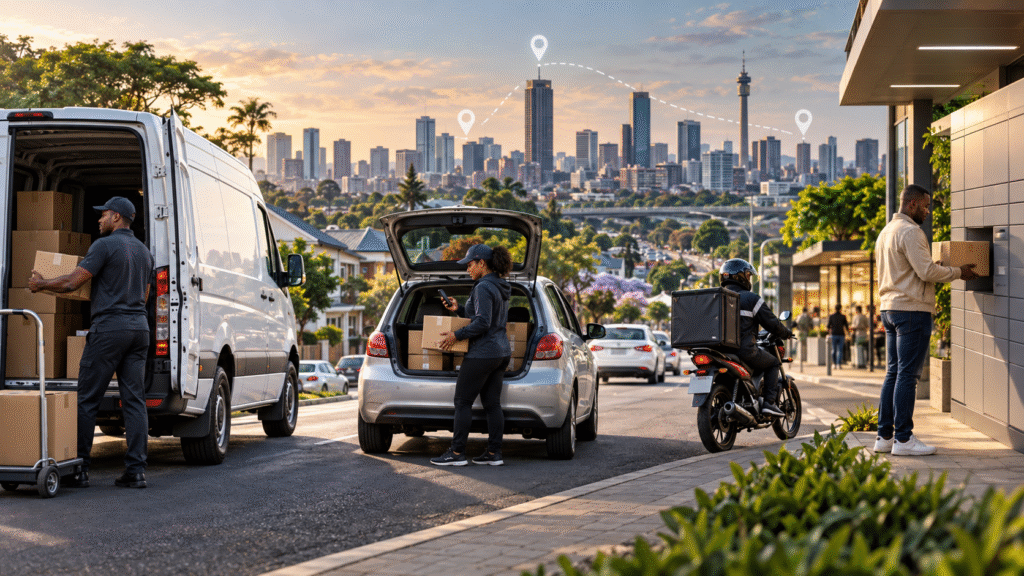
A parcel can now be delivered by a traditional courier company, an owner-driver, an Uber driver, a motorcycle delivery rider, or an e-commerce company’s own delivery network. Alternatively, the courier driver can be removed from the first and last mile almost entirely by using a parcel locker or retail collection point.
This is particularly important for companies whose traditional business has been built around small parcels.
PAXI’S R60 parcel has changed customer expectations
There is a lesson here in consumer economics: companies have recognised one of the uncomfortable realities of courier delivery. The first and last kilometres are often the most expensive. In a recent presentation, speaking at E-commerce Live in Sandton, Diederick Stopforth, MD of Internet Express and Citi Sprint, stated that last-mile delivery makes up 41% of the total delivery cost.
Let’s see how this works in practical terms:
A traditional courier may send a vehicle several kilometres to collect one small parcel.
The parcel goes to a depot where it is sorted, stored overnight, and then line-hauled to another depot, where it is scanned and sorted, and then sent out with a driver to its final destination for “last-mile” delivery.
Compare this with PAXI and the locker networks, which change the entire distribution. A consignor can walk into a PEP store and send a parcel through PAXI for around R60 on its slower service.
PAXI network: consignments and efficiency
The consignor travels at his/her own cost to their local PEP store and deposits the parcel at a PAXI counter in-store. There are over 2700 PEP collection points all over South Africa.
PEP currently consigns more than 25 million consignments between its branches every year. By applying the PAXI model, it now gets huge economies of scale. Vehicles that were once returning empty are now loaded with PAXI Parcels.
An estimated 7.8 million parcels will be consigned annually through the PAXI network.
The consignee simply enters their nearest PEP store to get delivery of their parcel at a very low cost. The last-mile delivery cost has evaporated.
Once consumers get used to paying these low parcel fees, it alters their perception of what parcel delivery should cost. It is irrelevant to the consumer that the traditional courier incurred greater costs in delivering the parcel; they are only focused on the bottom-line cost to themselves.
The threat from Uber introduces a completely different threat
Uber already has thousands of people with vehicles moving around South African cities.
It doesn’t necessarily need to purchase another delivery vehicle, employ another traditional courier driver, or build another depot to deliver an additional parcel.
All a consumer has to do is open the Uber app and select the Courier, then enter the collection and delivery addresses. Uber gives you the price before you confirm the request. An available delivery person accepts the job and travels to the collection point.
The driver then travels to collect the parcel and then delivers it to the consignee. Admittedly, the delivery range is very small (on average less than 16 kilometres), and there are no official figures to measure how many Uber parcels are delivered annually. There are over 20,000 registered Uber drivers in South Africa.
The delivery service under threat here is the same-day small parcel delivery service where a traditional courier would find it difficult to match the economies-of-scale price of the Uber enterprise.
The EVRI Model
When I was introducing FreightGuard to the UK, I came across another fascinating parcel distribution model called the community courier.
The company that successfully developed this model was Hermes (the company changed its name to EVRI in 2022).
Under this model, members of the local community can use their own private vehicles to deliver parcels locally around their neighbourhood. A local housewife after the morning school run, or a part-time student with a vehicle needing to supplement their income, can arrive at the local EVRI depot and have, on average, 75 parcels per day scanned into their vehicle for local delivery.
Using the EVRI -ware Courier app, the courier downloads a parcel manifest, arrives at the local EVRI depot, and scans the parcels into their vehicle. The app provides route optimisation for each scanned parcel, which ensures that the community courier delivers the parcels in the most cost-effective manner.
Then there is Evri Plus.
This is fascinating because it is halfway between employment and self-employment. Couriers committing to five or more days per week can receive benefits including up to 28 days’ paid holiday and pension contributions, while retaining self-employed status. Evri has even arranged top-up courier insurance at £1.35 per day for the courier for 3rd party accident cover for every day they are active.
Will this happen in South Africa?
It is not in the realm of science fiction to imagine this happening in South Africa.
Both countries have similar-sized populations (in the region of 62–69 million), but there are 42 million registered drivers in the UK compared to 16 million in South Africa. Perhaps surprisingly, a full 38% of all registered vehicles are concentrated in Gauteng (5.9 million vehicles), and that would certainly lend itself to the Evri model.
When you consider that South Africa has a huge unemployment problem (around 32 % officially) there will surely be many currently unemployed drivers who would be willing to become community couriers.
Imagine this happening at scale in South Africa:
A woman living in Randburg owns a Toyota Corolla and wants to earn additional income as a courier. She registers with a parcel delivery platform. At 7h00 tomorrow, her phone tells her:
Northcliff
60 parcels
Estimated earnings: R600
She accepts. At 8h00 she arrives at a local distribution point.
The parcels are scanned into her custody, where the app has already calculated the most efficient delivery sequence. She spends the morning driving around Northcliff. Each delivery is scanned, photographed, or electronically recorded. By lunchtime, she has delivered 57 parcels. Tomorrow she may or may not work again.
For four hours, she has effectively become a courier company. The economics are extremely powerful. The community-courier model potentially converts a substantial part of the fixed costs that traditional couriers face into variable costs.
Need another 100 drivers during Black Friday and Christmas? Activate more independent drivers. Parcel volumes collapse in January? Don’t activate any more community couriers.
This way, the platform doesn’t have vehicles and employees sitting idle.
The community courier supplies the vehicle and bears much of the vehicle depreciation, the cost of fuel, tyres and wear and tear on the vehicle. The platform provides the technology, parcel density, and customers. That is a fundamentally different cost structure.
On 25 August 2026, Evri announced another 7,000 self-employed community-courier positions, alongside more than 2,000 owner-driver opportunities. The enlarged Evri Group now handles over one billion parcels annually and is targeting 1.4 billion by 2030
How could traditional couriers benefit from the Evri model?
Assume a well-developed traditional courier company like The Courier Guy, JKJ Express, or Aramex with large volumes of small parcels.
Let’s say 5,000 residential parcels arrive overnight in a depot. The software system divides them geographically into perhaps 70–80 delivery rounds, and the approved community couriers select or receive their rounds. They arrive at the depot, scan the parcels into their vehicle, and, using the route optimisation software, begin delivering their 75 parcels each. You would only need 66 drivers to complete the entire delivery.
The courier company retains the sophisticated part of the operation — customer acquisition, billing, sorting, linehaul, technology, tracking and claims — while potentially transferring much of the vehicle and labour cost of the final mile to a variable-cost workforce.
South Africa isn’t Britain — yet, but watch this space.
In the final analysis, the situation is best summed up as follows:
“The future of e-commerce delivery is not about choosing between the doorstep and the locker. It is about giving customers the freedom to choose where, when, and how they receive their parcels. The last mile needs to move from a delivery model built around the courier to one built around the customer.”
~ Diederick Stopforth, Managing Director, Internet Express & Citi Sprint.